Accelerate Your Career with SRESchool.in Site Reliability Engineering Tutorials
Introduction
Applications crash without warning, web pages crawl during peak hours, and midnight alerts overwhelm engineering teams. When production systems break unexpectedly, companies lose customer trust and valuable revenue. Fixing these recurring headaches requires abandoning manual firefighting in favor of structured engineering practices. Understanding how software interacts with cloud infrastructure helps teams stop outages before users notice. Platforms like SRESchool.in deliver the structured guidance professionals need to master modern reliability engineering. Adopting these core concepts allows you to build stable systems, eliminate repetitive manual toil, and maintain high availability during traffic surges.
What Makes Site Reliability Engineering Essential Today?
Site Reliability Engineering applies software engineering principles directly to IT infrastructure and operations. Traditional system administrators rely heavily on manual fixes and reactive troubleshooting when components fail. In contrast, Site Reliability Engineering treats operations as software challenges, leveraging code to manage infrastructure and automate responses. This discipline matters because modern applications run across complex cloud environments with numerous interconnected microservices. When services scale rapidly, manual interventions slow down and introduce human errors. Embracing these methodologies helps organizations balance fast feature delivery with rock-solid system stability.
Core Skills You Master Through SRE Training
Engaging with structured SRE Training equips engineers with practical methods for managing production environments successfully. Learners discover how to configure automated alerts, track critical metrics, and analyze application logs to spot bottlenecks early. Training programs teach technical staff how to define realistic reliability targets and handle system failures calmly. Participants also master automation techniques using modern scripting languages and configuration management utilities. Furthermore, comprehensive training covers capacity planning, incident management, and cloud architecture fundamentals. Developing these capabilities empowers professionals to resolve complex production incidents with total confidence.
Why Professionals Value SRE Certification
An SRE Certification validates a practitioner’s theoretical understanding and applied knowledge of core reliability principles. Many technology workers pursue certification to benchmark their expertise, organize their study path, and stand out in competitive job markets. Preparing for certification exams pushes engineers to review industry standards, incident handling protocols, and operational frameworks thoroughly. However, exam prerequisites and industry recognition vary depending on the chosen certification provider. Holding a certificate demonstrates professional dedication, but it does not guarantee hiring success, promotions, or salary increases. Real-world troubleshooting experience and system architecture competence remain the primary drivers of long-term career growth.
How to Select the Right SRE Course
Choosing an ideal SRE Course demands an honest evaluation of your current technical background and career objectives. Beginners should prioritize courses covering foundational topics like Linux systems, basic networking, and simple log monitoring. Advanced practitioners should target programs emphasizing cloud infrastructure, container orchestration, and complex incident management strategies. A quality course balances core theory with hands-on lab exercises and realistic examples. Always verify whether the curriculum addresses essential utilities such as version control systems, cloud platforms, and telemetry tools. Selecting the right program ensures an efficient learning curve tailored to your needs.
Mastering Site Reliability Engineering Training
Site Reliability Engineering Training shifts your mindset from reactive maintenance to proactive architecture design. Learners explore how to write code that provisions infrastructure, automates deployments, and heals applications automatically during minor glitches. Instead of chasing impossible hundred percent uptime targets, this training teaches engineers how to manage acceptable risk using error budgets. Participants analyze performance bottlenecks, write constructive postmortems, and refine deployment pipelines. Connecting engineering theory with real production scenarios prepares teams to build resilient software that handles heavy user traffic without collapsing.
Understanding Site Reliability Engineering Certification Value
Pursuing a Site Reliability Engineering Certification helps practitioners structure their learning around established industry guidelines. Candidates study essential topics like service level objectives, error budget management, telemetry collection, and automated rollout strategies. This focused preparation fills knowledge gaps that everyday workplace tasks often leave behind. Nevertheless, formal certification represents only one facet of professional development. Combining exam preparation with hands-on system building yields the strongest skill set. Employers look for practical engineering competence above all else, making real-world application vital.
Leveraging SRE Tutorials for Hands-On Learning
Following a detailed SRE Tutorial allows learners to master specific tools and techniques through clear, actionable steps. Tutorials provide immediate value for engineers who prefer practical experimentation over dense theoretical texts. You can use tutorials to build monitoring dashboards, configure log aggregators, or write infrastructure automation scripts. Combining conceptual study with interactive tutorials reinforces technical concepts and builds muscle memory. Debugging a sample application or setting up an alert rule via a tutorial gives you the practical confidence needed for live environments.
Exploring Essential SRE Tools and Their Functions
Modern engineering teams rely on specialized SRE Tools to track application health, automate workflows, and resolve operational bottlenecks quickly. Different utilities serve distinct roles across the software and infrastructure lifecycle.
| Tool Category | Core Function | Typical Operational Use Case |
|---|---|---|
| Metrics & Monitoring | Numerical data collection | Tracking CPU utilization, request latency, and throughput |
| Log Management | Centralizing event logs | Investigating error stack traces and application warnings |
| Tracing Systems | Request path tracking | Identifying performance bottlenecks across microservices |
| Infrastructure as Code | Resource management via code | Provisioning cloud servers and networks automatically |
Tool selection depends strictly on company budgets, existing architecture, team expertise, and operational demands. No single tool suits every organization.
Implementing Proven SRE Best Practices
Implementing SRE Best Practices helps technical teams maintain reliable services while shipping new software updates rapidly. Core practices include setting clear reliability goals through service level objectives, automating manual chores, and holding blameless postmortems after incidents. Teams also establish smart alert thresholds to prevent alert fatigue among on-call personnel. Furthermore, proactive capacity planning and load testing uncover hidden weaknesses before users experience service disruptions. Because every technical stack is unique, organizations adapt these practices to fit their specific operational environments.
What an SRE Engineer Actually Does
An SRE Engineer bridges software development and IT operations to safeguard system availability, performance, and scalability. These professionals divide their time between writing automation code, building monitoring pipelines, and responding to live production incidents. They collaborate closely with software developers to ensure upcoming features meet established stability thresholds prior to deployment. During outages, SRE engineers lead troubleshooting efforts to restore functionality rapidly. Afterward, they analyze root causes to prevent identical failures from happening again. Their primary mission centers on eliminating toil, optimizing cloud costs, and maximizing system reliability.
Decoding SLOs, SLIs, SLAs, and Error Budgets
Establishing precise metrics enables engineering teams to evaluate system health objectively and align technical work with business objectives.
- SLI (Service Level Indicator): A direct measurement of service performance, such as request latency or success percentage.
- SLO (Service Level Objective): A target reliability level chosen by the engineering and product teams.
- SLA (Service Level Agreement): A formal contract with customers defining uptime commitments and financial penalties for breaches.
- Error Budget: The permissible amount of unreliability or downtime allocated for testing and releasing new features quickly.
Reliability targets vary by service tier; a financial transaction platform demands much tighter thresholds than an internal staging server.
Harnessing Monitoring and Observability for Deep Insights
Monitoring and observability grant engineering teams deep visibility into complex production environments. Monitoring tracks predefined numerical metrics and triggers alerts when thresholds break, such as high CPU usage. Observability takes analysis further by combining metrics, structured logs, and distributed traces to explain unexpected system behavior. When a distributed application slows down, observability tooling lets engineers trace requests across microservices to pinpoint the exact failing component. Robust telemetry shortens troubleshooting cycles and accelerates service recovery during critical incidents.
Mastering Incident Management and Incident Response
Incident management provides a structured workflow for handling unexpected outages and service degradation smoothly. When problems occur, automated monitoring notifies the on-call engineer, who immediately investigates the root cause. Transparent communication protocols keep team members, stakeholders, and users informed throughout the event. Once engineers restore service, they conduct a blameless postmortem to analyze what went wrong without pointing fingers. The team focuses entirely on fixing underlying architectural flaws, updating documentation, and writing automated tests to block future failures.
Eliminating Toil Through Intelligent Automation
Repetitive manual tasks—known commonly as toil—drain engineering hours and introduce human error into operations. Automation replaces manual chores with robust software scripts, orchestration tools, and self-healing pipelines. For instance, instead of manually restarting failed application containers or configuring cloud servers individually, engineers write scripts that execute these tasks instantly. Reducing toil frees developers and operations staff to focus on strategic architecture projects, security hardening, and core product features. Automated workflows also guarantee uniform deployments across staging and production environments.
Designing for Cloud Reliability and Distributed Systems
Modern applications run on distributed cloud networks rather than single physical servers. While cloud platforms offer elastic scaling, they also introduce challenges like network jitter, hardware dropouts, and cross-region synchronization delays. Cloud reliability focuses on building fault-tolerant architectures that survive component failures seamlessly. Engineers deploy strategies like load balancing, multi-region redundancy, and graceful degradation to preserve uptime. Designing resilient applications ensures that localized infrastructure hiccups never cascade into widespread user outages.
Supporting SRE Workflows with Kubernetes and Terraform
Forward-thinking engineering teams leverage technologies like Kubernetes and Terraform to manage complex cloud infrastructure efficiently. Kubernetes automates container deployment, scaling, and operational management across server clusters while providing built-in self-healing mechanisms. Terraform enables infrastructure as code, allowing engineers to declare cloud resources in version-controlled configuration files. Managing infrastructure through code guarantees repeatable environment provisioning and eliminates configuration drift. Tool adoption always depends on an organization’s specific technical architecture, team skills, and project requirements.
Constructing an Effective SRE Learning Path
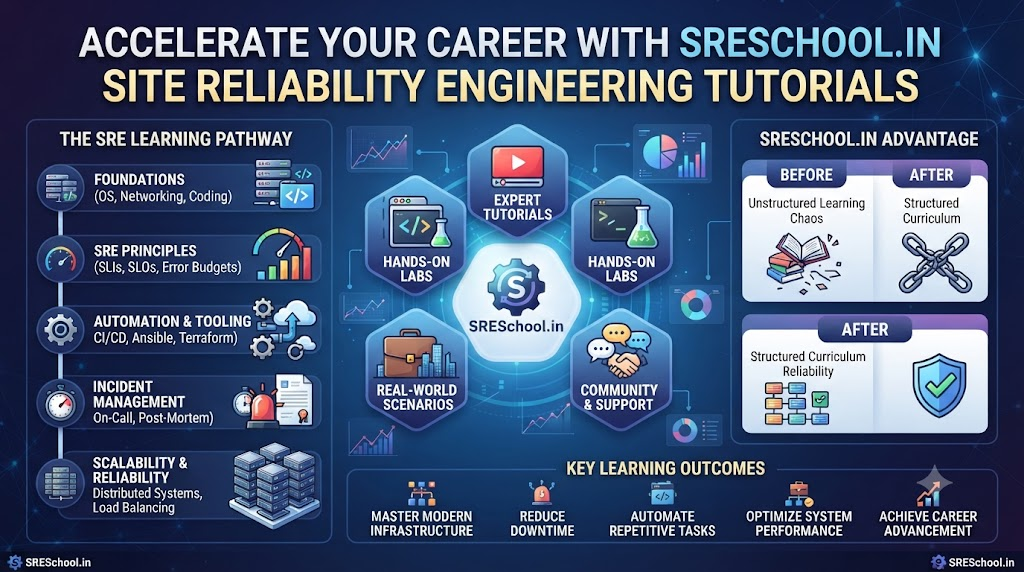
Building professional competence in reliability engineering requires following a structured progression from foundational concepts to advanced operations.
- Master System Basics: Learn Linux administration, computer networking fundamentals, and Git version control workflows.
- Explore Containers and Cloud: Practice containerizing applications and deploying them on major cloud platforms.
- Implement Telemetry: Configure monitoring and logging tools to capture accurate application behavior data.
- Automate Infrastructure: Write scripts and configuration files to automate server provisioning and setup tasks.
- Study Reliability Frameworks: Learn how to define SLOs, manage error budgets, and conduct incident postmortems.
Navigating SRE Training in India
Technology professionals across India actively pursue practical skills in cloud management, automation, and reliability engineering to support expanding digital platforms. SRE Training in India helps developers, system administrators, and DevOps practitioners bridge the gap between software writing and production operations. Educational programs emphasize hands-on concepts like telemetry, infrastructure automation, incident handling, and container orchestration. Mastering these competencies prepares engineers to manage enterprise-grade production environments. Programs prioritize practical skill development and technical mastery without promising guaranteed job placements or fixed salary outcomes.
How SRESchool.in Accelerates Your SRE Learning Journey
SRESchool.in provides a comprehensive educational destination for individuals exploring SRE Training, certification prep, SRE Course materials, and practical SRE Tutorials. The platform simplifies complex concepts like cloud reliability, system monitoring, observability, and incident response into digestible lessons. Learners discover how to leverage popular SRE Tools and apply industry-standard SRE Best Practices to real scenarios. Whether you want to develop SRE Engineer capabilities or pursue SRESchool.in training paths, the platform offers structured guidance tailored to your technical growth.
Why Learning SRE Accelerates Technical Careers
As businesses migrate mission-critical applications to the cloud, maintaining uninterrupted software uptime becomes vital for commercial success. Frequent application downtime destroys customer trust and impacts bottom-line revenue, making reliability a top priority for modern enterprises. Mastering reliability engineering equips practitioners with a versatile skill set blending software engineering, systems administration, and operational troubleshooting. Learning how to manage scalable infrastructure, eliminate toil, and handle incidents effectively makes engineers indispensable members of any technology organization.
Frequently Asked Questions About SRESchool.in
What defines SRESchool.in as a learning destination?
SRESchool.in is an online educational hub offering structured tutorials, guides, and courses focused on Site Reliability Engineering, cloud reliability, automation, monitoring, and incident management.
Who benefits most from participating in SRE training?
Software developers, DevOps specialists, system administrators, and IT professionals aiming to build, scale, and secure reliable cloud architectures benefit significantly.
Does SRESchool.in issue official certification credentials?
The platform provides educational content and study guides designed to help learners master core reliability concepts and prepare for independent industry certification exams.
What core topics does a standard SRE course cover?
An SRE course typically addresses Linux fundamentals, cloud reliability, service level indicators, objectives, error budgets, telemetry collection, and incident response workflows.
Is prior programming experience mandatory to become an SRE engineer?
Writing code or scripts is highly beneficial because SRE professionals build automation utilities, infrastructure templates, and custom monitoring tools.
Are technologies like Kubernetes and Terraform compulsory for all SRE roles?
No single tool is mandatory across the industry; technology choices depend entirely on corporate architecture, team expertise, and budget constraints.
How do monitoring and observability differ in practice?
Monitoring tracks predefined metrics to alert teams of failures, whereas observability combines metrics, logs, and traces to uncover the underlying causes of system anomalies.
What function does an error budget serve in engineering?
An error budget defines the acceptable margin of system downtime or failure over a set period, balancing rapid feature releases against stability needs.
Does completing SRE training in India guarantee employment?
No educational program can guarantee job placement or salary levels, but acquiring practical skills helps professionals prove their technical competency to employers.
Where should absolute beginners begin studying SRE best practices?
Beginners should start by mastering Linux administration, networking basics, cloud concepts, and following guided tutorials available on platforms like SRESchool.in.
Final Thoughts
Mastering Site Reliability Engineering demands ongoing curiosity, continuous study, and hands-on experimentation. By prioritizing workflow automation, robust telemetry, clear reliability objectives, and blameless postmortems, practitioners transform fragile applications into resilient systems. Educational resources like SRESchool.in simplify the process of exploring structured training, tutorials, and proven best practices at your own speed. Honing your practical troubleshooting skills and architectural knowledge enables you to build dependable cloud infrastructure that delivers consistent value to users.
Leave a Reply