The Ultimate Playbook for Evaluating Modern Software and AI Solutions
Executive Summary
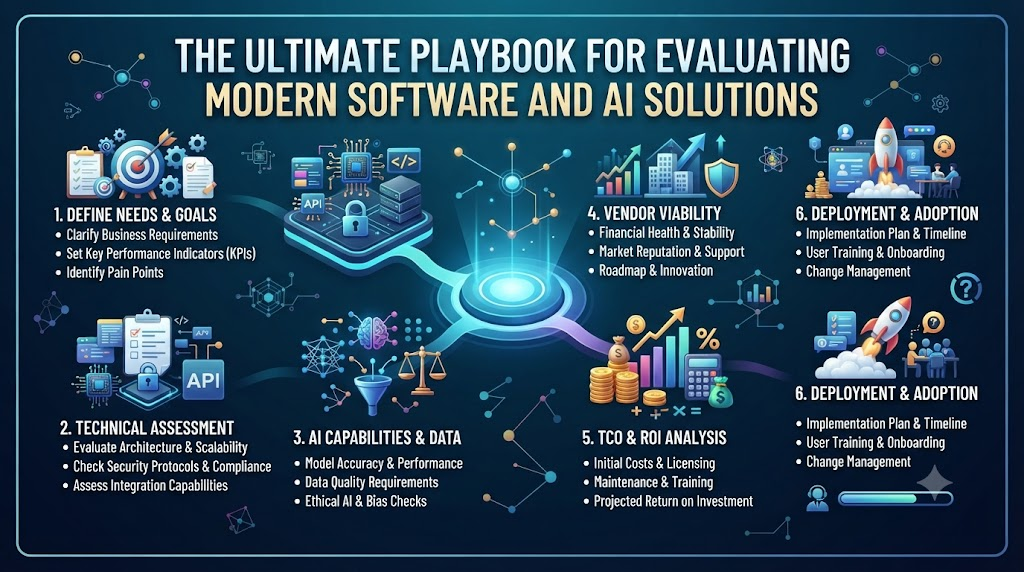
Selecting digital tools demands precision, clarity, and systematic evaluation. Organizations face an overwhelming volume of software choices across every functional category. Evaluating candidates side by side exposes hidden pricing tiers, integration gaps, and operational friction before you commit resources. Leveraging structured directories, unbiased user evaluations, and hands-on trial periods ensures your technology stack directly advances your business strategy.
Key Decision Framework for Software Procurement
| Selection Criterion | Core Operational Question | Direct Business Impact |
|---|---|---|
| Functional Alignment | Does the platform solve our precise daily pain point? | Prevents capital waste on unused, bloated feature sets. |
| Total Ownership Cost | Will our budget support these recurring seat costs? | Guarantees financial predictability and protects cash flow. |
| User Experience | Can employees achieve mastery within hours? | Eliminates long training cycles and boosts adoption. |
| System Interoperability | Does the API link cleanly with active stack tools? | Maintains data accuracy and removes manual data entry. |
| Information Security | Does the vendor comply with rigorous safety protocols? | Defends proprietary records against malicious data breaches. |
Why Rigorous Software Benchmarking Matters
Navigating the modern software market requires a disciplined framework. Purchasing software without side-by-side analysis frequently leads to unexpected subscription increases, poor user adoption, and security vulnerabilities. When buyers analyze candidate platforms through structured comparison matrices, they quickly isolate key differentiators:
- Financial Predictability: Exposing hidden seat tiers, storage limits, and add-on fees protects operating margins.
- Operational Velocity: Selecting intuitive, highly interoperable platforms accelerates daily employee output.
- Risk Mitigation: Verifying encryption standards and compliance certificates keeps sensitive data protected.
- Future Scalability: Choosing modular architectures ensures your software suite expands seamlessly as your organization grows.
Platform Spotlight: Navigating BestAIToolix.com
BestAIToolix.com operates as an independent research hub designed to streamline software discovery for decision-makers, engineers, and department heads. The platform categorizes thousands of specialized applications across core operational domains:
- Artificial Intelligence: Machine learning models, automated content tools, and predictive analytics engines.
- Infrastructure & Cloud: Enterprise storage, serverless hosting, and database management systems.
- DevOps & Engineering: CI/CD pipelines, code repositories, and automated testing frameworks.
- Cybersecurity & Compliance: Endpoint protection, identity access management, and threat monitoring.
- Marketing & Sales: Automation engines, CRM systems, and campaign analytics tools.
- Finance & Human Resources: Automated payroll platforms, accounting ledgers, and workforce management suites.
The platform enforces strict editorial independence, rejecting paid positions or vendor sponsorships to ensure every rating reflects verified capability.
Evaluating Artificial Intelligence Applications
Evaluating artificial intelligence tools requires specific metrics beyond standard software checks. Organizations must look closely at model accuracy, processing latency, and data privacy policies.
- Define Specific Deliverables: Identify the exact task the model must perform, such as automated code generation or customer query resolution.
- Benchmark Output Precision: Run identical prompt sets across multiple candidates to measure error rates and output quality.
- Inspect Data Governance: Confirm that the vendor does not use your internal business data to train public foundation models.
- Calculate Usage Limits: Analyze token rates and API call caps to forecast true monthly operating costs accurately.
Step-by-Step Software Acquisition Roadmap
- Document Pain Points: Map out the exact operational bottlenecks your team needs to eliminate.
- Draft Feature Checklists: Categorize essential capabilities versus optional functionality.
- Establish Capital Caps: Set strict upper bounds for per-user monthly expenditures.
- Explore Directory Listings: Filter target categories inside structured repositories to uncover top candidates.
- Assemble Shortlists: Select three to four standout options that meet primary criteria.
- Execute Benchmark Comparisons: Analyze candidate parameters side by side using unified scorecards.
- Audit Compliance Terms: Inspect vendor data handling policies, SLA guarantees, and backup procedures.
- Initiate Pilot Tests: Deploy trial accounts to test live workflows under realistic work conditions.
- Collect User Feedback: Gather direct input from frontline employees during trial runs.
- Finalize Procurement: Choose the platform that balances cost, security, and usability.
Critical Errors to Avoid During Tool Selection
- Falling for Trend Hype: Buying tools based on social media momentum rather than business utility leads to abandoned software. Fix: Validate candidate tools against real operational metrics before spending budget.
- Ignoring Seat Multipliers: Looking only at single-user rates leads to budget shocks when scaling across large teams. Fix: Multiply base costs across your total headcount before approving purchase orders.
- Bypassing Hands-On Pilots: Buying long-term contracts without testing daily usability often yields low team adoption. Fix: Require key stakeholders to complete full work cycles during free trial periods.
- Overlooking Integration Needs: Purchasing isolated tools creates data silos and forces manual data entry. Fix: Verify native integrations and API access prior to contract execution.
- Neglecting Support SLAs: Choosing low-cost options without dedicated support leaves teams stranded during outages. Fix: Balance subscription savings against vendor response times and support availability.
Frequently Asked Questions
1. How does a digital software directory simplify procurement?
Directory platforms catalog thousands of applications into searchable, indexed categories. Decision-makers instantly filter options by deployment type, functional capability, and price range. Utilizing a central index cuts research time from weeks to hours while introducing viable alternatives you might otherwise miss.
2. What value do independent software reviews offer?
Unbiased evaluations present honest assessments from active industry professionals using the software in production. Independent reviewers decline vendor sponsorships, exposing platform bugs, hidden fees, and support weaknesses clearly. Reviewing these objective reports prevents costly implementation failures.
3. Why should teams utilize a dedicated AI tools directory?
An AI directory groups machine learning applications by specific output domains, including image generation, text processing, and code synthesis. Prospective buyers compare models directly on speed, token pricing, and data retention policies. This structured view helps teams select reliable tools that produce accurate results.
4. What insights does a side-by-side software comparison reveal?
Comparative analysis measures competing tools against identical operational criteria on a single dashboard. Evaluators assess subscription tiers, API connectivity, security compliance, and user limits simultaneously. This side-by-side examination reveals which candidate offers maximum return on investment.
5. Why must managers audit software security policies?
Reviewing vendor security standards ensures your team protects customer information and proprietary files. Organizations must verify encryption methods, data center locations, and regulatory compliance certificates like SOC 2 or GDPR. Thorough security audits prevent costly data breaches and legal liabilities.
6. How can buyers spot exaggerated vendor sales claims?
Marketing materials frequently overstate software capabilities while hiding implementation costs and steep learning curves. Wise buyers verify vendor assertions through independent review sites, peer references, and live trial testing. Grounding decisions in empirical proof protects your organization from underperforming software.
7. What represents the best initial step in software evaluation?
Begin by writing a comprehensive specification document detailing your workflow problem and essential feature requirements. Set a firm budget limit before searching structured directories for matching products. Select three top candidates, compare their parameters side by side, and test them via trial accounts.
8. How does BestAIToolix maintain objective product ratings?
BestAIToolix enforces strict editorial guidelines that bar vendor payments, paid inclusions, and sponsored rankings. The platform relies on verified user experiences, technical benchmarks, and transparent evaluation criteria. This commitment ensures buyers receive objective facts during every search.
9. What makes free trial periods essential before purchasing?
Free trials allow your workforce to test software functionality within your actual operational environment without financial risk. Hands-on testing exposes interface flaws, speed bottlenecks, and missing features before contract signature. Testing applications firsthand offers the most reliable proof of enterprise utility.
10. How do native integrations increase workplace efficiency?
Native integrations enable automatic data synchronization across distinct software platforms without manual intervention. For example, linking a CRM with your accounting software updates invoice records the moment a deal closes. Automated data flow eliminates repetitive data entry tasks and prevents human errors.
11. Which product categories does BestAIToolix cover?
BestAIToolix catalogs applications across all major enterprise technology sectors. Users explore solutions for artificial intelligence, cloud infrastructure, cybersecurity, DevOps, marketing, finance, HR, and project management. Browsing these specialized hub pages helps teams find targeted tools for any operational need.
12. How frequently should an enterprise audit its active software stack?
Organizations should audit active software subscriptions at least once a year. Annual reviews help managers identify inactive user accounts, consolidate duplicate tools, and renegotiate expiring contracts. Regular audits ensure your technology stack remains efficient, secure, and cost-effective.
Final Summary
Strategic software selection demands clear operational requirements, thorough market research, and rigorous pilot testing. Document your core requirements, enforce firm budget caps, and compare finalist platforms side by side using structured directories. Inspect security standards and validate performance through hands-on trials before committing enterprise capital. Relying on objective research platforms like BestAIToolix equips your organization with the verified facts required to build a powerful tech stack.
Leave a Reply