Navigating Global Mobile Network Identifiers: A Comprehensive Telecom Research Manual
Introduction
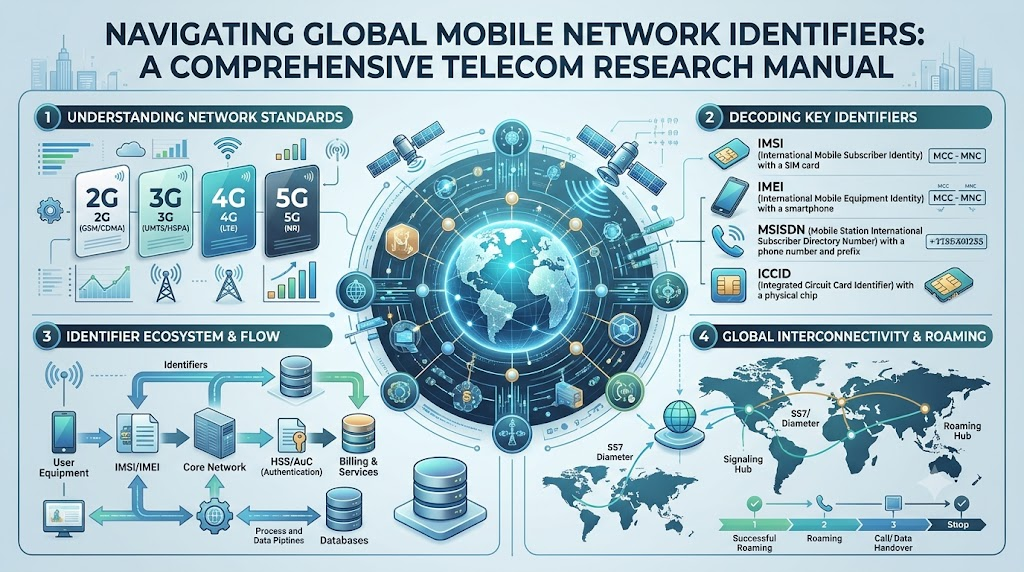
Every second, millions of wireless devices transmit data packages across international borders. Standardized numerical identifiers manage this entire process behind the scenes, directing traffic to the correct cellular towers and server destinations. These critical codes indicate the exact country and network operator responsible for each connection. Software developers, telecom analysts, and system architects depend on these numerical identifiers every day to build software, test roaming setups, and analyze telecommunications markets.
Obtaining clean, verified network records often presents significant challenges for technical teams. Operators merge, change corporate names, and update regulatory filings continuously. Independent platforms like eSIMGlobo organize these shifting datasets into clean, searchable reference directories. This practical handbook details how network codes function, how to research global operators, and how to maintain high data accuracy across technical projects.
Fundamentals of MCC MNC Lookup
An MCC MNC Lookup gives researchers a direct way to identify official network code assignees. Cellular networks broadcast two specific numbers to announce their identity:
- Mobile Country Code (MCC): Identifies the designated geographic country or global region.
- Mobile Network Code (MNC): Identifies the specific operator or business holding the code assignment.
Joining these two numerical parts creates a unique network identity string. For example, pairing MCC 310 (United States) with MNC 410 (AT&T Mobility) produces the complete identifier 310-410.
When you query an MCC MNC combination, the search tool retrieves the registered assignee name from authoritative regulatory files. National regulators allocate these numbers following International Telecommunication Union (ITU) E.212 recommendations.
Reviewing official ITU records confirms the legitimate assignees behind every network string. Keep in mind that a code assignment does not always match a consumer brand name. Some infrastructure owners hold code assignments while hosting separate virtual service providers. Recognizing this operational difference prevents major misinterpretations during technical research.
Decoding Network Records via PLMN Code Lookup
A Public Land Mobile Network (PLMN) represents an entire wireless communication system operating under a single management team. A PLMN Code Lookup uses the combined country and network digits to pinpoint the registered assignment holder.
A standard lookup breaks down the full code into distinct structural components:
- Country Digits (MCC): 310 (United States)
- Network Digits (MNC): 410 (AT&T Mobility)
- Resulting PLMN Code: 310-410
Engineers and software developers rely on PLMN codes to configure SIM profiles, direct roaming traffic, and set up network routing. Running a lookup confirms which business holds the official regulatory assignment. However, looking up a PLMN code differs from verifying actual tower coverage. An operator can hold a valid PLMN assignment even if it lacks active cell towers in a specific local region.
Exploring the Mobile Network Operator Directory
A Mobile Network Operator Directory organizes complex regulatory files into structured, user-friendly company listings. Instead of sorting through raw data files, researchers can inspect clean, verified provider profiles.
Core Data Fields in Operator Listings
- Legal Entity Names: Displays the official legal business holding the code assignment.
- Assigned Network Codes: Lists the exact MCC and MNC pairs registered to the company.
- Geographic Scope: Defines the country, territory, or global zone where the code applies.
- Authoritative Source Links: Links directly to official ITU E.212 documents or national regulatory filings.
- Assignment Status: Clarifies whether the code remains active, reserved, or returned.
- Timestamp History: Records the exact date of the latest information update.
Utilizing structured operator profiles accelerates comparative market studies. When directory listings match official government files, you can catch outdated information quickly. This clear structure keeps international research projects on track.
Operating the Global Telecom Provider Directory
A Global Telecom Provider Directory compiles thousands of individual network records from across the globe into one unified knowledge center. Managing telecommunications data across hundreds of individual nations can quickly overwhelm technical teams. A centralized database simplifies this task by storing scattered global entries in a uniform format.
A global provider directory categorizes records into distinct operational groups:
- National Assignments: Groups entries by individual geographic areas, such as Belgium (MCC 206) or Canada (MCC 302).
- International Ranges: Tracks specialized network services using global ITU codes, including MCC 901 for maritime or satellite systems.
- Assignee Profiles: Connects every number entry directly to its verified corporate owner.
Centralized provider directories assist companies in planning international connectivity and testing global software applications. They also yield valuable insights for competitive market analysis. Because local laws vary by region, researchers must always review country-specific regulations alongside standard directory listings.
Inspecting Mobile Network Codes by Country
Reviewing Mobile Network Codes by Country allows analysts to examine how regulatory bodies allocate wireless identifiers within specific borders. Every nation uses one or more assigned country codes. Local regulatory agencies then distribute individual network codes to operating telecom companies.
A Step-by-Step Code Research Workflow
- Select the Target Region: Choose the specific nation or island territory for your study.
- Identify the Country Code: Locate the assigned three-digit MCC for that location.
- List Assigned Network Codes: Gather all active MNC numbers under that specific country code.
- Identify Registered Assignees: Review the registered organization name next to each code pair.
- Verify Status and Timestamps: Confirm that the code assignment remains active and up to date.
- Check National Regulators: Consult local regulatory offices when making major business investments.
Adhering to these practical steps keeps your research data clean and accurate. You can evaluate national spectrum distribution without confusing commercial brand names with underlying network holders.
Structure of the Mobile Country Code List
A Mobile Country Code List focuses on three-digit country identifiers rather than individual company records. This geographic index organizes data strictly by regional borders. For example, MCC 206 designates Belgium, while MCC 302 marks Canada.
| Identifier Type | Digit Count | Primary Function | Example Case |
| Mobile Country Code (MCC) | 3 Digits | Marks the country or geographic area | 206 (Belgium) |
| Mobile Network Code (MNC) | 2 or 3 Digits | Marks the assigned operator inside a country | 01 (Proximus) |
| PLMN Code | 5 or 6 Digits | Forms the complete, unique network string | 206-01 |
An MCC value alone never points to a single company. Larger nations like the United States rely on multiple country codes, including 310, 311, and 312. Analysts must combine the country code with a network code before drawing technical conclusions.
Data Verification in Telecom Operator Databases
A Telecom Operator Database tracks both current and historical network assignments across global markets. Reliable databases record complete assignment details, including source references, active status tags, and legal assignee names.
A verified database entry maintains essential technical details:
- PLMN Identifier: 232-01
- Legal Assignee: A1 Telekom Austria
- Country Location: Austria (MCC 232)
- Primary Source: Official ITU E.212 Filings
- Current Status: Verified and Active
Tracking data provenance—the origin and update history of every record—protects technical projects from costly errors. Regulators update code assignments regularly due to corporate mergers, license returns, or infrastructure upgrades. Platforms like eSIMGlobo use documented data histories and official ITU E.212 source files to help researchers track market shifts accurately.
Investigating Virtual Carriers in the MVNO Directory
A Mobile Virtual Network Operator (MVNO) sells cell phone plans directly to consumers without building its own physical tower infrastructure. Instead, the virtual operator leases network access from a traditional mobile carrier. Because of this wholesale setup, the consumer brand on a smartphone screen often differs from the owner of the network code.
While some virtual operators receive their own dedicated network codes, many share host codes with their primary carrier. A planned MVNO Directory will help researchers study virtual brands, underlying wholesale contracts, and business models. Separating virtual brands from physical network owners ensures accurate technical analysis.
Emerging Features: The eSIM Provider Directory
An eSIM provides a digital alternative to standard plastic SIM cards. Devices with built-in eSIM chips can download digital cellular profiles without physical card swaps. Travelers and international businesses rely on eSIM services to maintain fast, low-cost data connections abroad.
A planned eSIM Provider Directory aims to consolidate vendor information into one clear directory. This tool will help users evaluate provider identities, supported travel destinations, compatible devices, and service plans. Since device support and carrier partnerships vary across brands, a structured directory simplifies the research process for global travelers.
Automating Queries via the MCC MNC Lookup API
An API (Application Programming Interface) connects different software applications so they can share information automatically. An MCC MNC Lookup API enables developers to send automated code requests and receive instant assignment details in return.
Automated lookups follow a quick three-step process:
- System Query: An app sends a code pair, such as MCC 232 and MNC 01, to the API endpoint.
- Database Matching: The system compares the query against verified directory tables.
- Data Return: The API sends back the matched assignee name, returning “A1 Telekom Austria”.
Developers can use planned API features and structured data exports to streamline technical workflows. An application can identify an incoming user’s carrier automatically to select optimal network settings. Automated lookups eliminate manual searches and keep software databases updated continuously.
10 Critical Pitfalls in Telecom Research
Researching telecommunications codes requires rigorous attention to detail. Minor oversights can cause application bugs or faulty market analysis. Avoid these ten frequent mistakes:
- Confusing MCC with MNC: An MCC designates the country, while an MNC designates the operator. Treat them as two distinct components of a single identifier.
- Assuming Codes Match Consumer Brands: Assignment lists record legal code holders, not retail brands. Examine wholesale contracts to identify consumer-facing brands.
- Ignoring Record Timestamps: Telecom assignments change over time. Verify update dates before integrating data into active systems.
- Relying on Unverified Sources: Unofficial online lists often contain formatting errors. Stick to official ITU E.212 publications and government regulator files.
- Assuming Guaranteed Signal Coverage: A code assignment does not prove physical tower coverage in every city. Check live operator coverage maps for actual service boundaries.
- Confusing Host Carriers with MVNOs: Host operators own physical cell towers, while MVNOs rent capacity. Research host contracts to understand physical infrastructure ownership.
- Assuming Universal eSIM Support: eSIM features require compatible device hardware. Review device specifications before purchasing digital profiles.
- Mistaking Future Features for Live Tools: Platform development plans include upcoming resources. Distinguish live lookup utilities from features listed as planned or developing.
- Failing to Document Source References: Unlabeled code data creates verification problems later. Record the source name and access date for every network code entry.
- Expecting One Global Database to Cover Everything: No single directory captures every private roaming deal. Cross-reference global platform lists with local regulatory filings for complete accuracy.
Best Practices for High-Accuracy Telecom Audits
Adopting structured research habits keeps your data accurate and reliable. Always cross-check primary documents, such as official ITU E.212 publications or national regulatory bulletins. These authoritative source files list the official legal assignees.
Maintain thorough documentation habits across your team. Save verification dates, status notes, and geographic context alongside every network code pair. When making important technical or financial choices, verify your conclusions across multiple trusted databases. Documenting your source notes ensures that your team works exclusively with verified facts.
| Verification Checklist Item | Why It Matters | Official Verification Location |
| Code Pairing | Confirms that the MCC and MNC digits align correctly. | Official ITU E.212 publications |
| Legal Assignee | Identifies the official legal owner of the code. | National regulatory filings |
| Geographic Scope | Establishes the exact national or territorial borders. | Government telecom lists |
| Primary Reference | Documents where the entry data originated. | Official publication bulletins |
| Assignment Status | Clarifies if the code is active, reserved, or returned. | Registry change logs |
| Record Timestamp | Prevents the use of outdated network details. | Update histories and logs |
Strategic Value of eSIMGlobo in Telecom Research
eSIMGlobo acts as an independent global telecom provider directory. The platform helps researchers, developers, and industry experts research mobile network operators across global markets. Core lookup tools search official ITU E.212 entries to provide clear assignee information.
The platform separates its features into clear operational categories:
- Active Research Tools: Users can search official ITU E.212 records, look up network codes by country, and confirm operator assignees.
- Developing Platform Services: eSIMGlobo is working on future tools, including an MVNO directory, an eSIM provider directory, and a developer MCC MNC Lookup API with structured data exports.
Users can explore network codes by country, review operator profiles, and evaluate verified assignment data. As eSIMGlobo grows, planned additions like the MVNO directory, eSIM provider directory, and developer API will expand technical research options. The platform delivers accessible telecom data while maintaining strict verification standards.
Practical Applied Research Scenarios
Scenario 1: Developer Verifying Routing Profiles
A software engineer is building a connectivity tool that selects device routing profiles automatically. The engineer needs to confirm the owner of code pair 232-01.
- Action Steps: The engineer executes a code search, locates MCC 232 (Austria), and identifies MNC 01.
- Result: The system confirms A1 Telekom Austria as the legal assignee.
- Key Takeaway: Verifying code entries before app launches prevents routing errors in live software.
Scenario 2: Analyst Studying Regional Allocations
A telecom market analyst wants to compare network allocations across two European markets.
- Action Steps: The analyst filters network codes by country, extracts the assignment lists, and compares active codes against historical filings.
- Result: The analyst tracks how regulators shifted spectrum between primary carriers and virtual providers.
- Key Takeaway: Grouping network codes by country reveals national market structures clearly.
Scenario 3: Consultant Auditing Assignment Dates
A connectivity consultant must verify whether a specific network code remains active.
- Action Steps: The consultant searches the code pair, checks the source document, and reviews the timestamp log.
- Result: The consultant discovers that the operator returned the code pair to the national regulator six months ago.
- Key Takeaway: Checking update timestamps prevents teams from relying on obsolete telecom records.
Frequently Asked Questions
What is MCC MNC Lookup?
Executing an MCC MNC lookup query allows you to check official telecom registries for assigned mobile network codes. The search matches your requested country code and network code against authoritative files like ITU E.212 entries. This process reveals the registered owner, helping developers and researchers verify code assignments rapidly.
What is PLMN Code Lookup?
Searching a PLMN code performs a lookup on the complete numerical string formed by combining country and network codes. This combined code identifies a specific Public Land Mobile Network assignment. While the lookup identifies the legal code owner, it does not confirm active physical tower coverage or live service availability in a specific city.
What is a Mobile Network Operator Directory?
Accessing a Mobile Network Operator Directory displays official network-assignee records in a clean, searchable database format. It presents corporate assignee names, assigned numbers, geographic scopes, and source documentation links. Industry analysts use operator directories to review verified records, monitor registry updates, and compare network carriers across international markets.
What is a Global Telecom Provider Directory?
Using a Global Telecom Provider Directory offers researchers a single hub for international telecom data. It helps users analyze assigned network codes, discover active mobile operators, and examine provider details across countries. Centralizing these scattered resources simplifies global research for developers and market analysts.
How can I find Mobile Network Codes by Country?
Checking a structured telecom provider directory gives you direct access to mobile network codes by country. Select your chosen location to locate its assigned Mobile Country Code, then review the corresponding list of Mobile Network Codes and assignee names. Always confirm these listings against official ITU publications or national regulatory bulletins.
What is a Mobile Country Code List?
Reviewing a Mobile Country Code List maps geographic regions directly to their assigned three-digit numbers. This reference links specific countries or territories directly to their assigned country codes. Unlike an operator directory, this index focuses strictly on national boundaries rather than individual company assignments. An MCC value alone never identifies a specific network provider.
What information does a Telecom Operator Database contain?
Consulting a Telecom Operator Database reveals structured data points about mobile network assignments. Standard database entries contain network codes, legal assignee names, geographic boundaries, primary source links, verification statuses, and update timestamps. Quality databases preserve data provenance so researchers can confirm where every record originated and how recently regulators modified it.
What is an MVNO Directory?
Utilizing an MVNO Directory provides a dedicated space for researching virtual network operators. Mobile Virtual Network Operators offer mobile services to consumers by renting capacity from physical network owners. A dedicated virtual operator directory helps researchers analyze virtual brands, study wholesale partnerships, and separate consumer marketing brands from core network assignments.
What is an eSIM Provider Directory?
Exploring an eSIM Provider Directory creates a centralized hub for studying digital SIM service providers. It aims to display vendor profiles, supported travel destinations, device compatibility details, and available service plans. This future resource will help travelers and technical teams evaluate remote plans, compare provider options, and verify international connectivity options.
What is an MCC MNC Lookup API?
Integrating an MCC MNC Lookup API gives developers a way to automate network code queries programmatically. An API connects internal applications directly to telecom databases, allowing systems to request country and network code data automatically. Businesses use structured data exports and API integrations to keep their internal databases updated automatically.
Where can I verify mobile network code assignments?
Examining official International Telecommunication Union E.212 publications provides the most reliable way to verify mobile network code assignments. National telecom regulatory agencies also publish official assignment charts for their respective countries. Independent directories like eSIMGlobo compile these official source files to make telecom research faster and more accessible.
How does eSIMGlobo support telecom research?
Offering a searchable database of global network identifiers allows eSIMGlobo to support international telecom research effectively. It offers lookup tools grounded in official ITU E.212 records, operator listings, and country-level code indexes. The platform is also developing future services, including an MVNO directory, eSIM provider directory, and developer API.
Concluding Best Practices for Technical Teams
Applying systematic data verification prevents critical bugs and costly configuration errors in connectivity systems. Clear, up-to-date network records enable software engineers, system architects, and market researchers to verify operator credentials, map global infrastructure, and deploy reliable software products. Because national regulators update code assignments continuously, verifying primary documentation and checking record timestamps remains an essential requirement for every project. Independent reference tools like eSIMGlobo simplify this workflow by compiling official ITU E.212 filings into an accessible, searchable information hub. Before deploying network code datasets into production software, confirm your code combinations against the latest official ITU regulatory releases.
Leave a Reply