TheAIOps.com: A Comprehensive Guide to Intelligent Operations Platforms
Introduction
Modern technological ecosystems expand continuously, generating massive telemetry streams that often overwhelm legacy monitoring tools. Engineering teams struggle constantly to maintain absolute system uptime while managing endless notifications, logs, and performance metrics. Artificial intelligence for IT operations offers robust methodologies to solve these modern infrastructural hurdles. Consequently, technical leaders actively seek structured educational resources to navigate this digital transformation successfully.
Understanding Artificial Intelligence for IT Operations
Intelligent operations platforms merge big data analytics with advanced machine learning algorithms to automate enterprise infrastructure management. Traditional monitoring software relies on rigid static thresholds that trigger excessive false alarms and miss subtle performance degradation. Modern systems analyze historical telemetry to establish accurate behavioral baselines across distributed cloud environments. Therefore, engineering personnel gain profound visibility into system health without wasting hours on manual log reviews. Operational teams leverage these capabilities to shift completely from reactive firefighting toward proactive reliability engineering.
Why AIOps Is Becoming Important for Modern IT Operations
Modern cloud environments and microservices architectures generate unprecedented quantities of operational metrics across multiple deployment tiers. Human operators cannot manually inspect every log entry, trace, and metric stream during critical production incidents. Intelligent platforms bridge this operational gap by processing massive datasets instantly to uncover hidden performance bottlenecks. Furthermore, faster root-cause identification minimizes expensive downtime and protects vital corporate revenue streams. Organizations adopt these advanced methodologies to scale their IT capacity seamlessly without inflating operational headcount.
What Professionals Can Learn Through AIOps Training
Structured training programs equip engineers with the practical competencies required to design, deploy, and maintain intelligent IT systems. Learners investigate core disciplines including intelligent monitoring, anomaly detection, event correlation, and predictive analytics.
- Intelligent Monitoring: Transitioning past basic threshold alerts toward dynamic baseline tracking mechanisms.
- Anomaly Detection: Spotting subtle behavioral deviations across complex distributed infrastructure nodes.
- Event Correlation: Grouping related alerts together to eliminate operational noise during outages.
- Automated Remediation: Triggering self-healing workflows to resolve recurring infrastructure faults automatically.
Understanding AIOps Certification and Professional Skill Validation
Certification programs validate technical proficiency and demonstrate professional commitment to contemporary infrastructure management standards. Professionals pursuing formal credentials study architecture design, data pipeline ingestion, machine learning deployment, and workflow automation. While credentials do not guarantee specific promotions or salary increases, they establish a recognized benchmark for technical competency. Hiring managers frequently seek validated expertise when assembling high-performing reliability and DevOps teams. Earning a professional badge helps engineers distinguish themselves within competitive job markets.
Choosing an AIOps Course for Practical Learning
Selecting an appropriate educational course demands careful evaluation of curriculum depth, lab availability, and practical alignment with production environments. Comprehensive learning paths cover foundational concepts, integration architectures, and troubleshooting strategies for cloud platforms.
| Educational Stage | Core Study Focus | Practical Learning Objective |
| Foundations | Telemetry, Monitoring, Data Collection | Understand how raw operational data feeds analytical engines. |
| Core Technologies | Machine Learning, Event Correlation | Master pattern recognition and alert noise reduction. |
| Implementation | Roadmap Design, Tool Integration | Deploy intelligent workflows safely inside enterprise setups. |
Exploring AIOps Consulting for Organizations
Enterprises planning digital modernization initiatives frequently engage specialized consulting partners to navigate complex architectural shifts. Consultants audit existing monitoring maturity, pinpoint automation gaps, and design customized adoption roadmaps aligned with business targets. Professional advisory services help engineering leaders avoid common pitfalls during data pipeline creation and software selection. External experts bring valuable experience from diverse enterprise deployments across multiple industry sectors. Strategic guidance ensures technology investments directly support operational reliability objectives.
Understanding AIOps Services and Their Business Use Cases
Enterprise service portfolios include discovery workshops, architecture planning, data engineering, and custom workflow development. Businesses leverage these services to streamline incident management, reduce Mean Time to Resolution, and boost application performance. For example, retail platforms utilize automated event correlation to detect database latency spikes before customer checkout paths fail. Service providers assist internal teams in configuring machine learning models to match unique infrastructure topologies. These targeted use cases demonstrate measurable operational value and system resilience.
Exploring AIOps Tools for Intelligent IT Operations
Selecting appropriate software tools requires rigorous evaluation of integration capabilities, scalability, and operational usability. Organizations must assess how candidate platforms handle log ingestion, metric collection, and distributed tracing data.
- Data Integration: Connecting effortlessly with existing monitoring agents, log shippers, and cloud APIs.
- Observability Support: Consolidating metrics, logs, and traces into a unified analytical workspace.
- Anomaly Detection Engines: Applying machine learning algorithms to identify unusual system behavior accurately.
- Scalability and Usability: Processing high-throughput telemetry streams while maintaining an intuitive user experience.
Understanding What an AIOps Platform Does
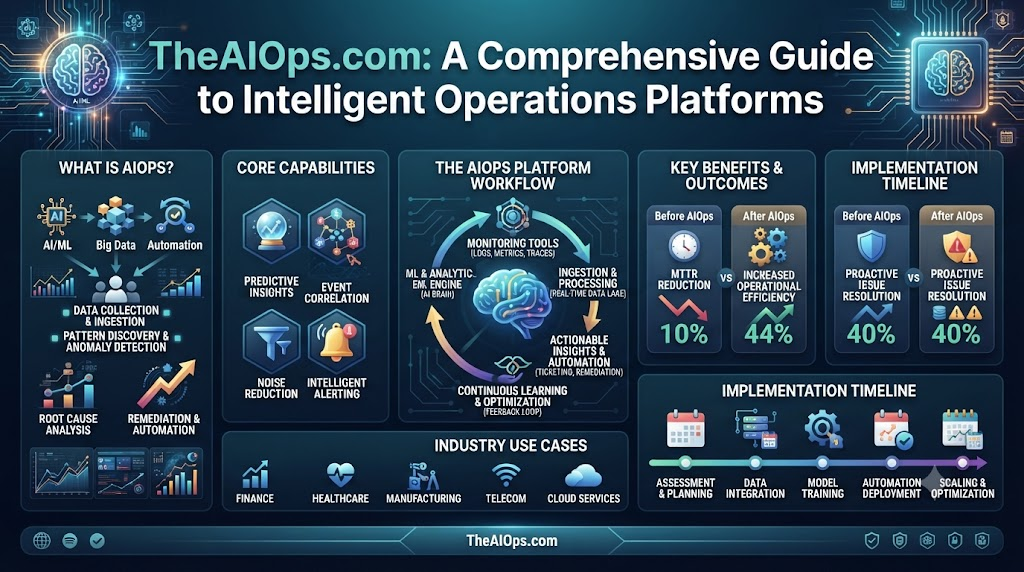
An enterprise platform serves as the core analytical engine for modern infrastructure and application operations. These platforms ingest telemetry from diverse sources, normalize metrics, apply machine learning models, and deliver actionable insights. Specific capability depths vary by vendor, platform configuration, and enterprise use case requirements. Primary functions typically include reducing alert fatigue, correlating disparate events, and forecasting potential system failures. Centralizing telemetry gives engineering teams a reliable single source of truth during crises.
Planning and Managing AIOps Implementation
Successful deployment requires a methodical strategy beginning with clear operational objectives and baseline metric measurements. Teams must catalog existing data sources, refine noisy monitoring alerts, and launch pilot projects prior to broad rollout. Change management plays a vital role as engineering staff adapt to new automated remediation procedures.
| Implementation Phase | Core Activities | Primary Success Metric |
| Assessment | Audit current monitoring and data inputs | Complete inventory of telemetry sources. |
| Pilot Testing | Deploy anomaly detection on one service | Measurable reduction in test environment noise. |
| Scaling | Expand data pipelines and correlation rules | Faster overall incident response times. |
Understanding the Role of an AIOps Engineer
Engineers specializing in intelligent operations combine traditional administration skills with data science and automation expertise. Professionals in this role build telemetry pipelines, tune machine learning models, and construct automated incident workflows.
- Systems Thinking: Comprehending how distributed applications and underlying infrastructure interact constantly.
- Data Proficiency: Writing queries, analyzing log structures, and managing time-series databases.
- Automation Skills: Developing scripts and orchestration playbooks to resolve routine operational faults.
- Collaboration: Partnering closely with SRE and DevOps groups to optimize monitoring strategies.
How AIOps Supports Monitoring, Observability, and Incident Management
Traditional monitoring informs teams when systems break, whereas advanced observability explains the root causes behind failures. Intelligent platforms enhance observability by correlating metric anomalies with recent software deployments and configuration modifications. During critical incidents, automated event grouping minimizes alert spam and guides responders directly to failure origins. Streamlined incident workflows accelerate cross-team communication and shrink service restoration times. These enhancements directly protect service level objectives and elevate customer satisfaction.
Using AIOps for Anomaly Detection and Event Correlation
Anomaly detection algorithms analyze historical behavioral baselines to flag unusual performance drops without manual threshold tuning. When an underlying failure triggers hundreds of dependent alerts, event correlation groups those notifications together. Instead of investigating fifty separate alerts, on-call engineers receive a single concise incident ticket. This intelligent grouping eliminates alert noise and prevents operator exhaustion during overnight support rotations. Effective correlation depends on accurate topology mapping and clean data pipelines.
Understanding Root-Cause Analysis and Predictive Operations
Pinpointing the exact origin of a complex software failure requires analyzing millions of interlinked log events. Machine learning models assist engineers by tracing symptom propagation backward to identify initial triggering events. Predictive analytics leverage historical trends to forecast disk depletion, memory leaks, or database saturation before outages occur. Proactive maintenance thwarts catastrophic failures and ensures high availability for critical business applications. Organizations transition from reactive firefighting toward true predictive reliability engineering through these capabilities.
Exploring Automated Remediation and Operational Automation
Automated remediation enables systems to execute predefined scripts or workflows in response to known operational anomalies. For instance, if CPU utilization breaches safe limits on a node, the platform can restart services automatically. Strict guardrails and thorough testing remain mandatory prior to enabling automated write actions in production. Operational automation removes manual toil, allowing engineers to focus on architectural innovation. Balancing human governance with automated execution ensures safe system administration.
How AIOps Connects AI, Machine Learning, Data, and Automation
Operational success relies on connecting raw telemetry streams directly with intelligent analytical models. Artificial intelligence and machine learning algorithms process massive data volumes that exceed human analytical limits. Once algorithms detect an anomaly or predicted failure, automation engines execute corrective workflows instantly. This closed-loop cycle transforms passive data storage into an active, self-optimizing infrastructure ecosystem. Technology stacks must integrate smoothly across ingestion, analytics, and execution layers to achieve this synergy.
Building a Practical AIOps Learning and Adoption Roadmap
Constructing an effective learning plan requires balancing foundational knowledge acquisition with hands-on experimentation. Beginners should start by mastering basic observability concepts, monitoring tools, and introductory data analysis techniques. Organizations can follow a similar phased approach by targeting specific high-friction operational silos for initial automation pilots. Continuous feedback ensures learning outcomes and tool deployments align with actual business needs. A patient, structured roadmap minimizes implementation friction and builds technical competence.
How TheAIOps.com Supports AIOps Learning and Knowledge Discovery
TheAIOps.com functions as a specialized learning, consulting, and knowledge platform dedicated to advancing artificial intelligence for IT operations. The platform helps professionals and organizations explore how machine learning, big data, observability, and automation transform modern infrastructure. Learners find comprehensive resources covering training paths, professional certifications, courses, tools, and tactical implementation guidance. Whether building an engineering career or guiding corporate adoption, readers access practical insights designed for real-world application. The site brings together essential knowledge to support continuous professional growth across evolving tech ecosystems.
Why Reliable AIOps Information Is Becoming More Important
Rapid software proliferation generates significant confusion for engineering leaders seeking objective educational guidance. Unverified claims and marketing hype frequently obscure the technical principles behind intelligent infrastructure management. Reliable educational platforms cut through industry noise by delivering clear, factual, and structured explanations. Access to trustworthy knowledge empowers teams to make informed software evaluations and architectural choices. Prioritizing accurate information ensures sustainable skill development and successful technology integration.
Frequently Asked Questions About TheAIOps.com
What learning resources does TheAIOps.com provide for technology professionals?
The platform offers specialized educational materials, professional certification guides, structured courses, consulting insights, tool evaluations, and implementation roadmaps.
How do structured training programs assist engineering teams?
Training helps professionals master intelligent monitoring, anomaly detection, event correlation, root-cause analysis, and infrastructure automation.
Do formal certifications guarantee immediate career advancement?
Certifications validate technical capability, but career outcomes, job promotions, and salary levels vary across different employers and individual contexts.
What criteria matter most when evaluating software tools?
Key evaluation criteria include data integration flexibility, observability features, event correlation accuracy, scalability, usability, and operational fit.
Do all software platforms provide identical technical capabilities?
Platform feature sets and technical capabilities vary significantly by vendor, software configuration, and specific enterprise use case requirements.
How does event correlation reduce on-call alert fatigue?
Event correlation groups related alerts and redundant notifications into a single summarized incident ticket, removing unnecessary noise.
What core responsibilities define an engineer specializing in this field?
Engineers build data pipelines, tune machine learning models, design automation workflows, and collaborate with reliability teams to maintain uptime.
Does intelligent tooling completely replace legacy monitoring systems?
Intelligent platforms integrate with and enhance existing monitoring, observability, and ITSM tools rather than replacing every traditional workflow.
What initial steps should organizations take during implementation?
Teams should define operational goals, audit existing telemetry data, clean up noisy alerts, and run small-scale pilot projects.
Who gains the most value from platform educational resources?
IT professionals, DevOps engineers, site reliability engineers, system administrators, and engineering managers seeking operational modernization benefit greatly.
Final Thoughts
Achieving operational excellence in modern technical environments demands continuous education, strategic planning, and disciplined execution. Intelligent platforms and automated workflows provide essential capabilities for managing complex distributed architectures successfully. Leveraging structured resources from platforms like TheAIOps.com empowers engineering professionals to build lasting technical mastery. Begin exploring specialized learning pathways today to drive long-term operational success.
Leave a Reply